
“There’s really only one jazz singer, only one. Betty Carter”- Carmen McRrae
Wikipedia defines scat singing as follows,
In scat singing, the singer improvises melodies and rhythms using the voice solely as an instrument rather than a speaking medium. This is different from vocalese, which uses recognizable lyrics that are sung to pre-existing instrumental solos.
I hesitated before using the term “scat singing” in this piece as it has always struck me as having a slightly derogatory undertone, a bit like the distinction between a painter and a potter Also the term is only every applied to jazz singers-nothing wrong with the that- but jazz instrumentalists are accorded, rightly, the distinction of being improvising musicians while when singers improvise they scat!
Whatever I am in no doubt that the greatest scat singer in the history of jazz was Betty Carter (1929-1998) and this may surprise you for two reasons.; sadly, she is not that well known, and jazz has produced a core of remarkable scat singers going back 100 years. Historically think of Ella Fitzgerald, Sarah Vaughan, Mark Murphy and Carmen McRrae (who you’ll hear duetting with Betty Carter on my playlist). In terms of the contemporary scene think of such stellar singers as Ian Shaw, Kurt Elling, Norma Winstone and Cecile McClorin-Savant all of whom have been pushing the boundaries of vocal improvisation in their performances and recordings.
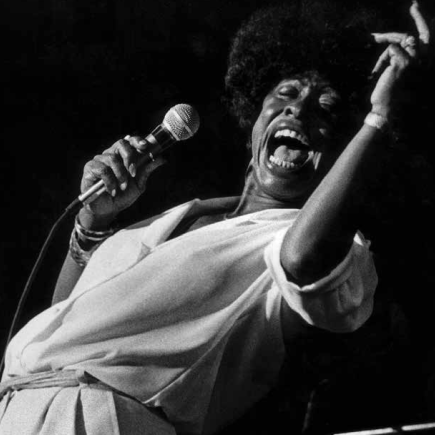
Betty Carter
I was fortunate enough to catch Betty Carter performing with the varied iterations of her accompanying trio at Ronnie Scott’s many times in the 80’s and 90’s. Images of Betty prowling the bandstand with her young band intimately attuned to every nuance of her performance- lightning shifts in tempo, and volume, with sudden pauses and unexpected endings- are amongst my most treasured jazz memories. Betty Carter was a hugely charismatic performer-you couldn’t take your eyes off her- but she was also a self-schooled musician who both trained and led her musicians to meet her own exacting standards and to develop and enhance their jazz credentials through their musical association with her.
In a recent Jazzwise profile Stuart Nicholson describes Betty Carter’s originality very well,
“Imposing herself upon her material in a way that no other singer has managed, Carter’s unique process of creative distortion refracted the contours of a song like images glimpsed in a hall of mirrors. She seldom, if ever sang the melody as written but nevertheless provided dramatic variety of the jazz singer’s art”
That reference to Carter’s refracting the contour of a song really emphasizes her astonishing achievement as a jazz vocalist and band leader. Carter was often criticised for her apparent lack of interest in/respect for the lyrics or even the tune. However, this misses the point. Carter saw jazz standards as a starting point for her art not an end in itself. As her early recordings indicate, Carter could enunciate a lyric along with the best of them, but as her career developed, particularly in her latter decades as a leader, it became increasingly obvious that reverence for the gods of the great American songbook was not where her deep interests lay. And this is what marks Betty Carter out as a true jazz genius.
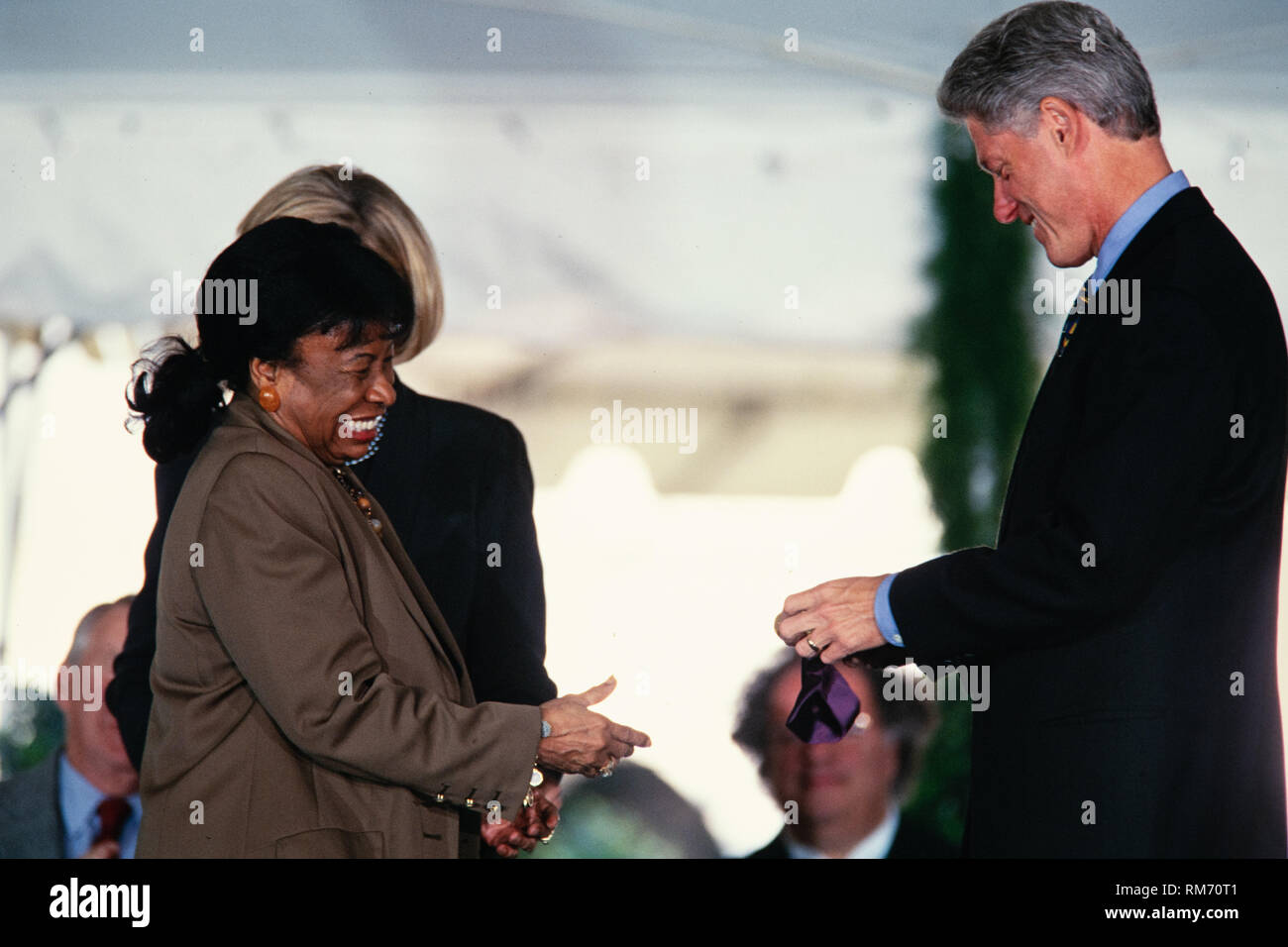
Betty Carter presented the National Medal of the Arts
Betty Carter, born Little Mae Jones in Flint Michigan began singing professionally at age 16 after she moved to Detroit. In interviews later in her life Carter often referenced the fact that she received very little love and support from her family and had to learn to be independent at a very early age Bebop master Dizzy Gillespie was an early mentor who recognised her precocious talent in the early 1950’s and particularly encouraged her to develop her talent for scatting.
Her first big break came in 1948 when she joined the renowned Lionel Hampton orchestra which initially featured Dizzy on trumpet and also included Wes Montgomery and Charles Mingus on guitar and bass respectively. Hampton’s band which had a huge popular following and toured intensively had at that time become a training ground for aspiring bebop players, including Charlie Parker with whom Betty performed briefly. Hampton’s wife Gladys gave Betty the nickname Betty Bebop which she detested but this spoke, albeit commercially to her ultra-modern jazz credentials.
Her next big break came in 1960 when she toured, on the personal recommendation of Miles Davis with Ray Charles’s orchestra and recorded Ray Charles and Betty Carter which became her only chart topping hit- although Ray Charles had quite a bit to do with that!
From the mid 1960’s to her final performances Carter became a bandleader nurturing and showcasing a remarkable array of much younger jazz musicians who served their apprenticeships with Betty before stepping out as leaders in their own rights. Lewis Nash, Benny Green, Jacky Terrason, Kenny Washington. John Hicks, Willard Harper and Curtis Lundy were just a few of the musicians who came to prominence with Betty. Carter played a very similar role as a talent spotter and mentor of next generation jazz musicians as Art Blakey did with his Jazz Messengers.
The aptly named short documentary- Betty Carter -New Every Time gives an insight into Carter’s extraordinary technique and presence as a leader both in rehearsal and performance.
Typically, as jazz went through one of its periodic downturns in the late 1960’s Betty Carter saw this as an opportunity to found her own recording company Bet-Car and to hit the road with her intensively schooled trios playing the jazz club circuit in the U.S. and Europe. In Betty’s own words,
“in fact, I think I was probably the first independent label out there in ’69. People thought I was crazy when I did it. ‘How are you gonna get any distribution?’ I mean, ‘How are you gonna take care of business and do that yourself?’ ‘Don’t you need somebody else?’ I said, ‘Listen. Nobody was comin’ this way, and I wanted the records out there, so I found out that I could do it myself.’ So, that’s what I did. It’s the best thing that ever happened to me. You know. We’re talking about ’69!
In the last 20 years of her life Carter set up JazzAhead an immersive summer camp for twenty teenage jazz aspirants which Betty led until shortly before her death. After which JazzAhead was taken over by the Kennedy Center in Washington DC where it remains-at least until Trump’s acolytes get to hear of it. The great pianist Geri Allen was one of the early alumni of this programme.
Here’s a short video covering the launch of JazzAhead and underlines Betty’s passion for and commitment to this project.
But it will be through her performances, particularly her live appearances in intimate clubs for which Betty Carter should be best remembered. She was a musician who took jazz to the very edge who could and did shift gear at the drop of a hat. A Maestra of both ultra slow tempi and burning fast speeds. And an independent black woman who throughout her career chose and personally managed her artistic path and ultimately owned her material and recordings.
So, if you haven’t yet heard of Betty Carter here’s your chance!
The Playlist
You’ll find early & late Betty, and a couple of great tracks from her legendary album with Ray Charles. I have chosen a number of tracks from her remarkable The Audience With Betty Carter album from 1980 which I think catches Betty at the peak of her career. The 25 minute Sounds track provides the best immersion into the sound world of Betty Carterr that you could find. To provide some context I end with a sample of classic vocal improvisations from some other star singers.
Recent Comments