
I am in no doubt that for optimum impact jazz needs to be experienced live and better still in a small club venue, ideally with an appreciative audience. Directly experiencing great musicians weaving improvisational patterns in real time forms a central component of what makes jazz unique. While contemporary jazz audiences tend to be attentive, that hasn’t always been the case, listening to bootleg recordings of Bird or Art Tatum, even early live recordings of Bill Evans and you can hear jazz masters battling to be heard against a background soundscape of cash registers and table-side conversations.
While I remember the impact of hearing Coltrane’s Love Supreme, Charlie Parker soaring through Au Privave or Monk’s trio version of Little Rootie Tootie on vinyl, nothing beats the immediacy of live performance. Hearing Mingus, Blakey and Rollins for the first time at Ronnie Scott’s ( all in my early 20’s) or McCoy Tyner’s band playing a 1AM closing set at the North Sea jazz festival or Didier Lockwood the late and great French trumpeter casting his spell over an audience in the Vendee deep in rural France on an outdoor stage with a medieval castle providing the backdrop- a setting and an experience that will be impossible to replicate. These are memories that define the jazz experience.
While most of my live listening going back to the late 1960’s (Stan Tracey at the long deceased Torrington pub in Finchley) has been in London I’ve also caught many live performances in the U.S. France and Holland. Venue size is often a function of the star quality and pulling power of the headline performer. If you wanted to see Miles Davis, Gil Evans or Ornette Coleman or want to catch Herbie Hancock, Brad Mehldau or Cecile McClorin Savant currently you needed to head down to London’s Royal Festival Hall or the Barbican-neither of which, to my mind are best set up acoustically to experience jazz. You have no choice; you have to be there.
I count myself lucky to have heard my idol, Sonny Rollins live at Ronnies in the early 70’s. All his subsequent appearances were at one of London’s largest concert halls. By this stage of his career Sonny preferred to cut down on his frenetic touring schedule of smaller jazz clubs and perform less frequently but more remuneratively at large concert venues, and no one can blame him.
I’d like to take you on a brief tour of jazz venues many of which remain part of my jazz life starting in my home city, London
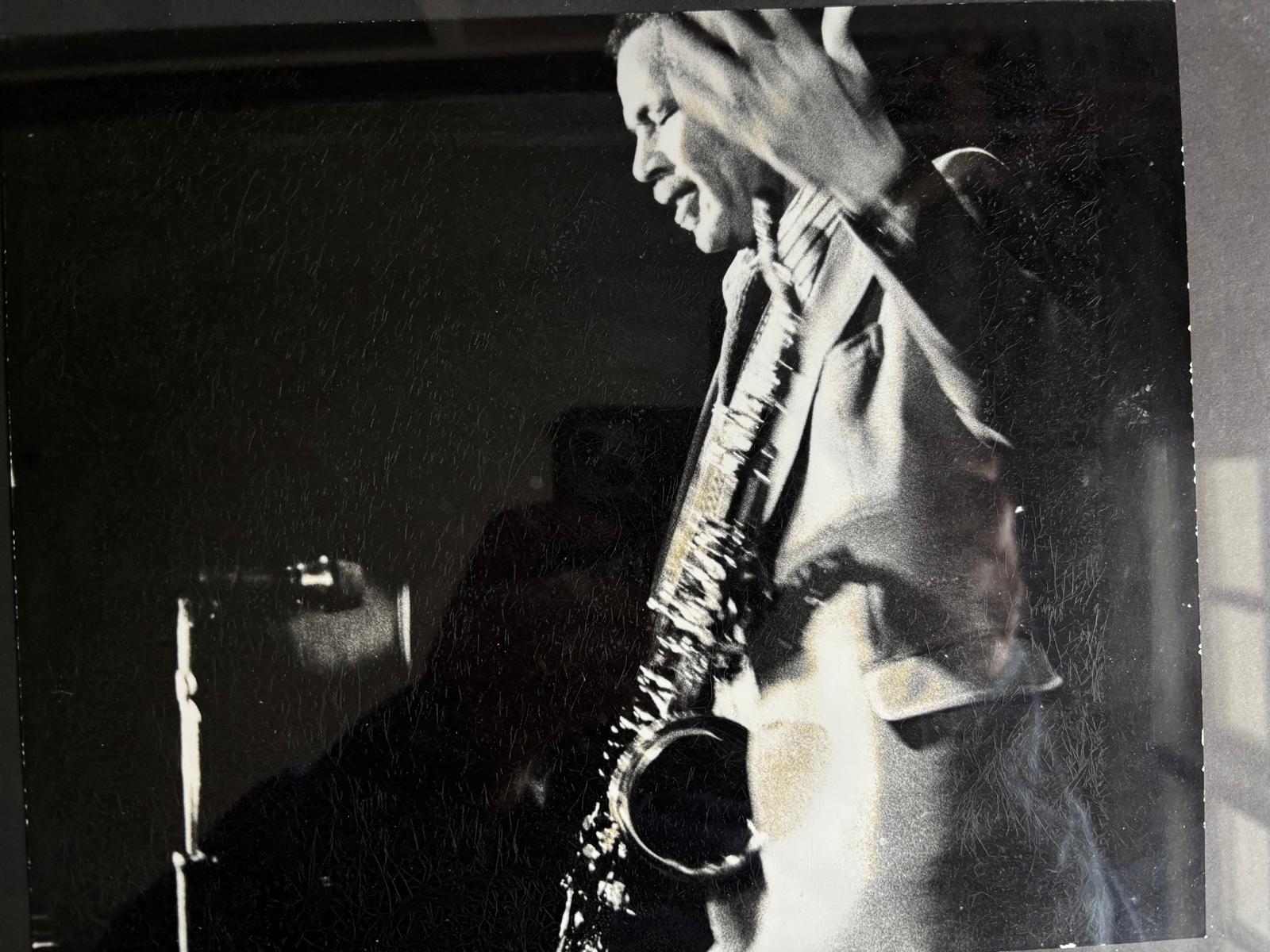
Dexter Gordon at Ronnie Scotts
In terms of club venues, the daddy of them all is Ronnie Scott’s where I saw Art Blakey playing 3 sets into the early hours in 1970 and plan to hear rising star vocalist and bassist Meshell Ndegeocello next week. 55 years of uninterrupted jazz listening in an optimum environment, originally founded by and for jazz musicians.
I am a regular at the volunteer-run Vortex in Dalston which specializes in cutting edge UK jazz with occasional appearances from bands from Europe and the U.S.
Three venues that are long gone but which featured memorable and influential gigs include the Peanuts Club in 70’s pre-gentrified Shoreditch where the volcanic alto player Mike Osborne held sway on a weekly basis in a cramped upstairs room above a sawdust-on-the floor East London boozer.
The Shaw Theatre in Kings Cross was the venue through the 70’s and 80’s for the annual weeklong Camden Jazz festival curated by Serious which remains an influential jazz promoter. Highlights included performances by Lee Konitz, George Coleman’s Octet and large scale commissions by Kenny Wheeler and Mike Westbrook.
In the early 1980’s Peter Ind the influential UK bass player who had recently returned from a 20 year sojourn in the States where he was part of the modernist circle that were schooled by Lennie Tristano opened a club in the basement of a Shoreditch warehouse, the Bass Clef. And ran it on a seven day a week basis until the pressure of combining his roles as club owner and player got too much for him.
The 100 Club in Oxford Street still claims to be London’s longest continuously functioning jazz venue, it opened in WW2. It still operates but jazz rarely features in its current schedule. A large, no-frills basement with almost no seating, in the 1970’s it was the place to go to hear top UK modernists, particularly Stan Tracey. I also recall some riotous evenings there hearing Chris McGregor’s Brotherhood of Breath playing their ultra-modern take on South African township music.
In recent years the Wigmore Hall, London’s pre-eminent venue for chamber music has opened its doors to jazz, at least on occasion. It provides an unrivalled setting and acoustic for unamplified jazz. I have heard Christian McBride, Brad Mehldau and Emmett Cohen there and am booked back for Emmett Cohen this November.
Being a north Londoner I rarely visit the 606 Club in West London, but it is a classic jazz venue with a great bookings policy
Turning closer to my home I am a regular at the weekly Jazz In Kentish Town gigs, also run by musicians upstairs at the Bull & Gate pub. And I have to mention the MAP Studio Café, also in Kentish Town where I play a monthly Sunday afternoon gig with my band the Equinox Jazz Quartet.
Until recently I visited New York, the cradle of contemporary jazz regularly. Many visits to the Village Vanguard the iconic and longest running jazz club in the States. Many of the live recordings on my playlist took place at the Vanguard. Sonny Rollins’s piano-less trio were the first to be recorded there in 1957.
And more briefly to name check the following New York club venues, all still plying their trade,
- Iridium
- Birdland
- The Blue Note
- Smalls
And the sadly closed Bradleys– a legendary hang out spot for jazz musicians between and after gigs, the Village Gate outside of which I posed with my great friend Andy, see below and Sweet Basil in the Village where the Gil Evans and the Thad Jones / Mel Lewis orchestras both held sway for many years.
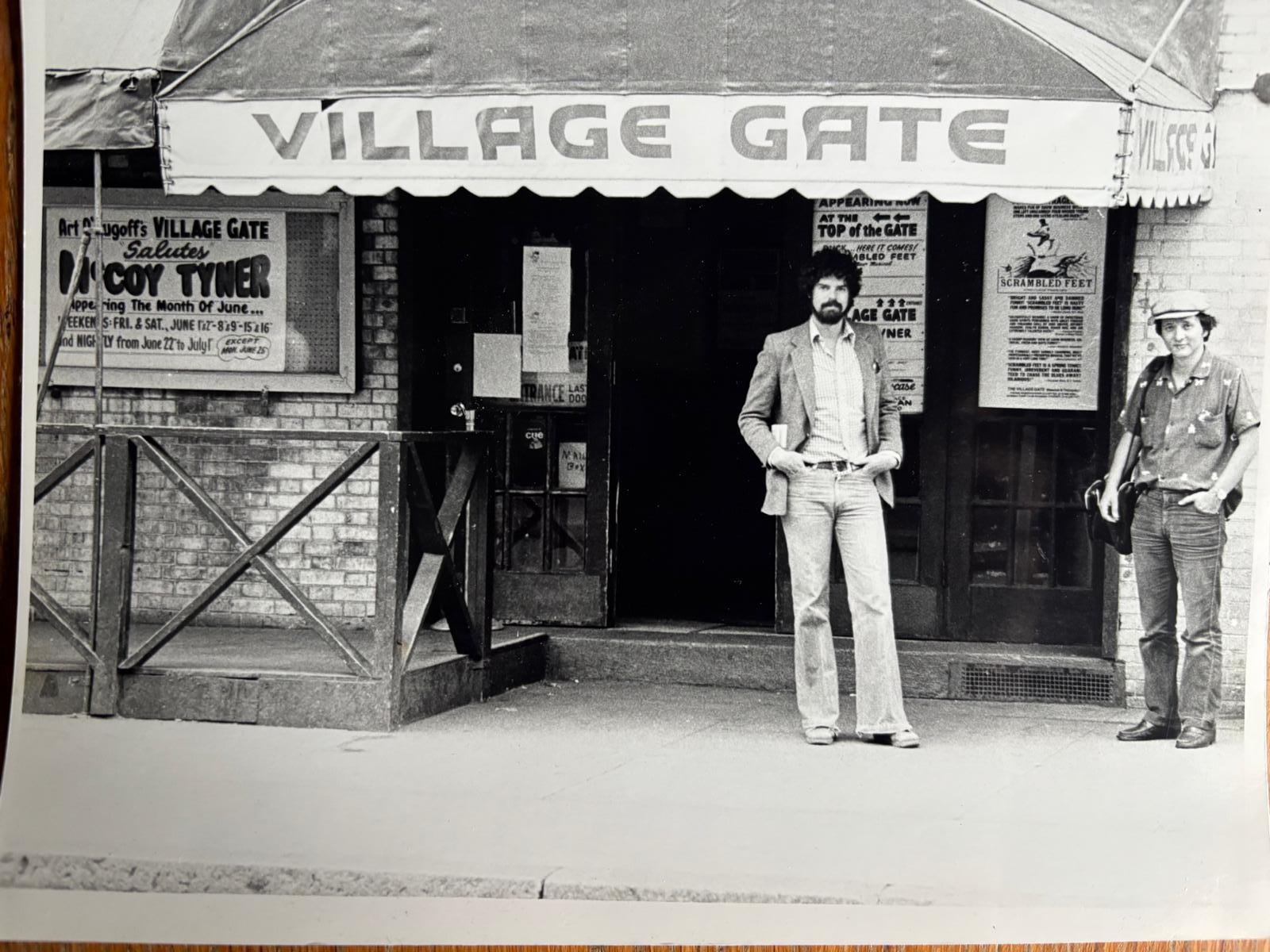
Village Gate
On an early visit to the Big Apple, I heard Max Roach’s quintet with a huge gospel choir playing an unforgettable performance at the Cathedral of St John in Harlem.
On a couple of trips to Chicago I stopped by Buddy Guy’s club and in D.C. caught a couple of great performance at Blues Alley that storied basement venue (a favourite of Dizzy Gillespie) to hear Christian Scott Atunde Adjung, a contemporary keeper of Dizzy’s flame on trumpet.
Finally, a standout live venue was at the also deceased Pasquale’s on Malibu pier owned by Herb Alpert’s bass player, Pat Senatore. The club sat on a promontory overlooking the Pacific ocean. You could hear the waves rolling in as an accompaniment to ballad playing. I heard George Cables’s trio there in 1979. Roll the clock forward 15 or so years and I attended a Cables gig at the Bass Clef and was astonished to learn from George when we spoke during the interval that he too had vivid memories of the waves accompanying his performance all those years ago on the west coast.
The Playlist
All but one of the tracks I have selected for this playlist are taken from live performances. The only exception being a beautiful version of Dexter Gordon’s Cheesecake by George Cables chosen to mark the two great Cables gigs I witnessed in LA and London and the interval conversation we had at the Bass Clef.
Many of the live recordings come from the Village Vanguard which is about to enter its 9th decade of continuous operation.
I hope you do enjoy.
Recent Comments