
In October 1967 I was thrilled when two great friends took me to see Miles Davis at the Hammersmith Odeon for my twenty-first birthday.
But my abiding memory is not of Miles, then fronting his second classic quintet featuring Herbie Hancock, Tony Williams, Wayne Shorter and Ron Carter, but the support free jazz saxophonist Archie Shepp. He strode on blazing away, followed one-by-one by his band, already playing as they entered. They sustained a fierce and wild energy for thirty-five minutes; then turned and walked off, still at full throttle, the sound slowly dying as they disappeared into the wings.
It was a bravura coup de theatre; a challenge from a rising to an established star.
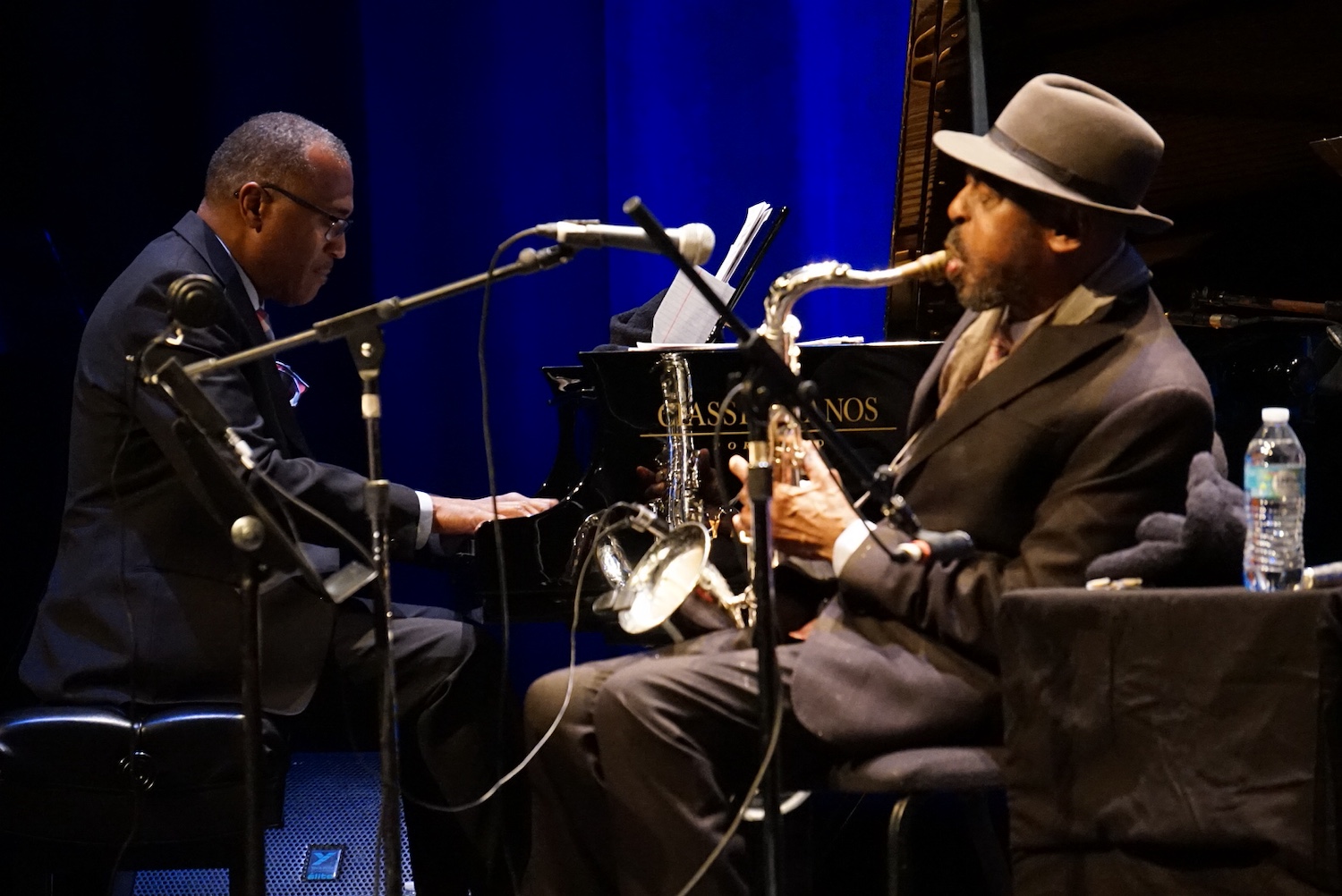
Lafayette Harris Jr & Archie Shepp
Cut forward to five years ago, the now 84-year old Archie Shepp was helped onto the stage of the Barbican Hall by pianist Jason Moran. They were to play a selection from their recent gospel album, Let My People Go. Shepp, a diminutive figure, in a dark suit that seemed a little too big, made sparing horn contributions from a seated position; carefully conserving his energy, but still fully in command. Then he launched into Go Down Moses and suddenly all frailty was gone. His voice seemed to come from somewhere majestic and deep, and to speak to the ages. I confess I teared up, and I wasn’t alone. When he finished, the audience rose unbidden to its feet.
In their later years, some artists, perhaps freed from the obligation to earn or impress seem to find a second wind. Leonard Cohen returned from his monastery cell to deliver a series of albums and live performances which are among his finest achievements; when painting became no longer possible Matisse created a new form of expression with his cut-outs; in his final deafness Beethoven still found the capacity to create his haunting last quartets; Ray Carver’s final poems, written when he’d had already learned he had but a few months to live, sum up a whole life with economy and grace; Tracey Emin’s rediscovered life drawing skills add a new dimension to her exploration of self; post-bereavement Patti Smith’s return to performance has been accompanied a stream of autobiographical works, new poetry, social media activity and an onstage dynamism that would be remarkable at any age let alone from someone entering her ninth decade.
And then, unforgettably, there are the late Rembrandt self-portraits, produced when he had suffered social exclusion, bankruptcy and the loss of those he loved most. As John Berger wrote: “He studied the damage unflinchingly…These portraits, like the late Beethoven quartets, have gained a very special authority, dark works about error, energy and endurance. Again, like the quartets, they are magnificently unresigned and uncomplaining.”
“There are no second acts in American lives” wrote F. Scott Fitzgerald; but in jazz, no less than in other fields of artistic endeavour, there are those who happily prove him wrong.
I caught Nat Adderley at the Jazz café with an enthusiastic and much younger band only a year or two before he died. For much of the set he was content to let them to do the heavy lifting, while he stepped forward for a few telling solos marked by an economy of effort but a lifetime’s learning, and virtuosity.
While some keep going, some never stop developing. As Jack Kerouac wrote there is an old Zen saying, “When you get to the top of the mountain, keep on climbing.”
Neither Miles Davis nor John Coltrane ever stopped climbing.
On Coltrane’s final studio album Expression, he continued to push the boundaries of what his saxophone and his music could achieve, sonorously magisterial in tone and approach, giving no hint of the fatal cancer he was suffering but never made public. I vividly recall the shock when I come across his obituary in the window of Doug Dobell’s Record Shop on Charing Cross Road; that such a torrent of ground-breaking work should be so brutally cut off in mid-flow.
Miles was always restless, never content to rest on his laurels, always innovating. For each new evolution of his sound he somehow discovered new talent, many of whom graduated from the university of Miles to become stars and band leaders in their own right. In so doing he changed the course of jazz, not once but over and over again. His final studio album Doo-Bop was a collaboration with a young hip hop producer and writer, Easy Mo Bee, just of one of many projects he was working on. He rarely looked back: always moving ahead once he’d mined a particular seam, he let it go.
On only one occasion did he make an exception, just a few weeks before he died.
For some time, his friend the composer, orchestrator and band leader Quincy Jones had been urging him to revisit some of the full orchestral works he had recorded decades before with Gil Evans notably on Birth of the Cool, Sketches of Spain, and Summertime. Miles was reluctant. As he said, “This shit is hard to play,” and even he was prepared to acknowledge that he was no longer in great shape. Eventually Jones won him over for a performance at the Montreux Jazz Festival in 1991 with members of the Gil Evans Orchestra. Despite minimal rehearsal he carried it off impeccably, even though he shared trumpet duties with the younger Wallace Roney who filled in seamlessly on the original score, while deferring to Miles for some sublime solos.
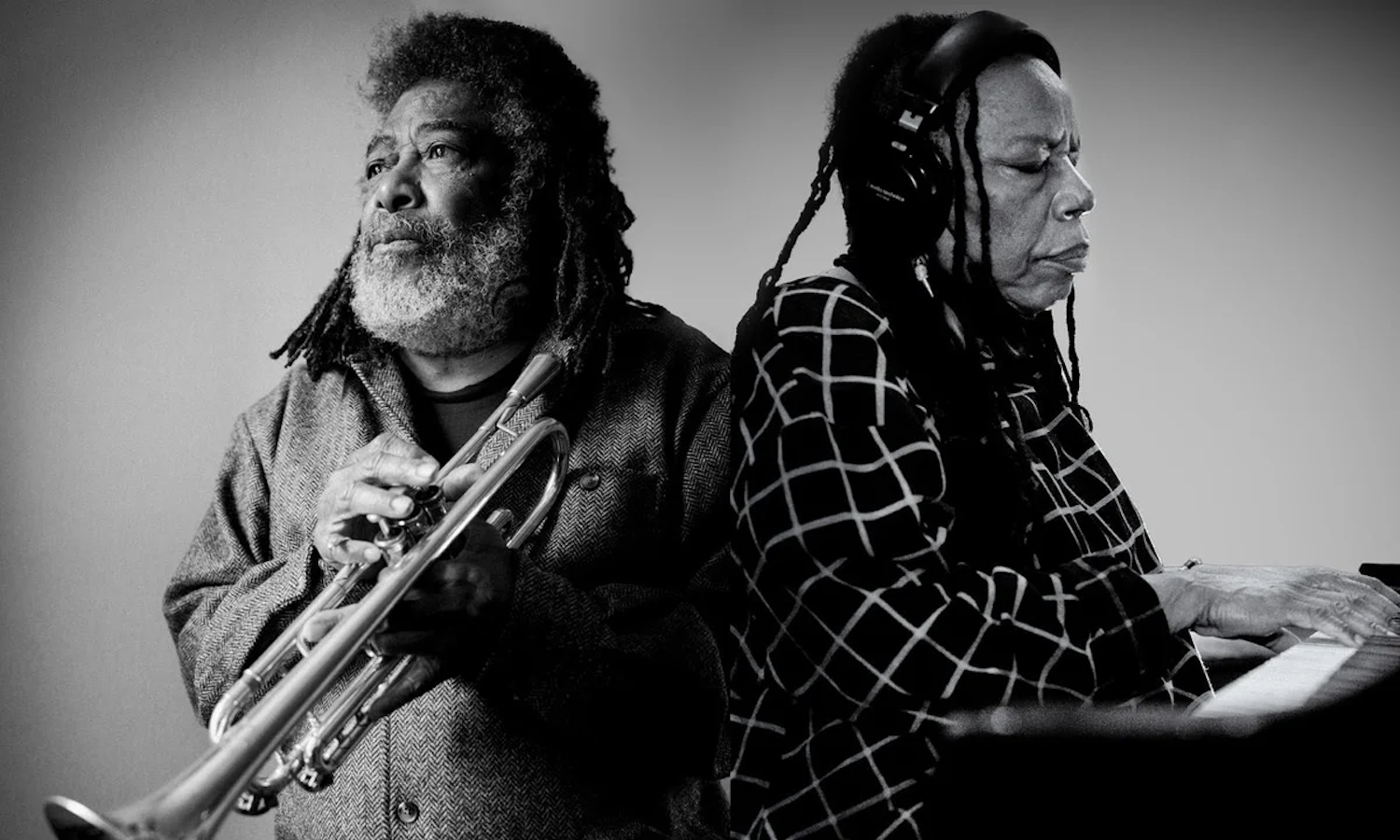
Wadada Leo Smith and Amina Claudine Myers
Conservatory Gardens is a musical conversation between trumpeter Wadada Leo Smith and Amina Claudine Myers, two illustrious alumni of Chicago’s incubator of free and experimental talent, the Association for the Advancement of Creative Musicians, rarely heard together: Smith in his eighties, Myers close behind. There is something very special going on here. The album is a slow-paced chamber piece, bearing the insights of two long careers on the music’s frontier, marked by a deceptive simplicity. On the title track Myers sets out on an almost mediative course and while Smith breaks in with piercing interventions on trumpet. They seem to tiptoe around each other as they slowly unpack the theme’s possibilities. Conservatory Gardens is the richly rewarding product of two great artists who no longer feel the need to show off, or dazzle with technical virtuosity.
In 1982 as one half of the Valentine Brothers, Billy Valentine wrote and recorded a minor soul hit “Money’s Too Tight To Mention”. Three years later it helped propel Manchester’s Simply Red to stardom. When the Brothers split up after four albums in the late ‘80s Billy moved into film and TV work, most recently providing the sound track to Boston Legal. Two years ago, now in his seventies, he made a triumphant return to recording in the company of some of the brightest stars of contemporary jazz, among them Immanuel Wilkins, Theo Croker, Jeff Parker, Larry Goldings, Linda May Han Ho and Pino Palladino. Billy Valentine & The Universal Truth, the first new record on the legendary Flying Dutchman label since 1976, produced by the son of the label’s founder Bob Thiele Jr., features songs by writers such as Curtis Mayfield, Prince, Stevie Wonder, Eddie Kendricks, and Pharoah Sanders. It is a moving and at times angry record, in part he has said, a response to recent events: in particular the death of George Floyd and the Black Lives Matter movement. To listen to his take on Gil Scott-Heron’s chilling Home is Where the Hatred Is gives a sense of his quiet strengths. As Richard Williams wrote on the record’s release: “Valentine brings the wisdom of his years to these “message” songs…this isn’t a jazz record any more than it’s a soul record, a funk record or an R&B record …. It’s all of them, mixed together in perfect proportions.”
An elder statesman of jazz enjoying a late career renaissance with a stream of notable albums and tours is the tenor saxophonist and flautist Charles Lloyd, now approaching ninety. His recent recordings in particular the Trios with a wide variety of distinguished collaborators, the quartet outing The Sky Will Still Be Here Tomorrow and another trio Figure in Blue, both the latter, parenthetically, like the Archie Shepp featuring the always imaginative Jason Moran on piano. This body of work shares a thoughtful, reflective quality with Smith and Myers’ Conservatory Gardens, and with the recent recordings and stage appearances by my final artist.
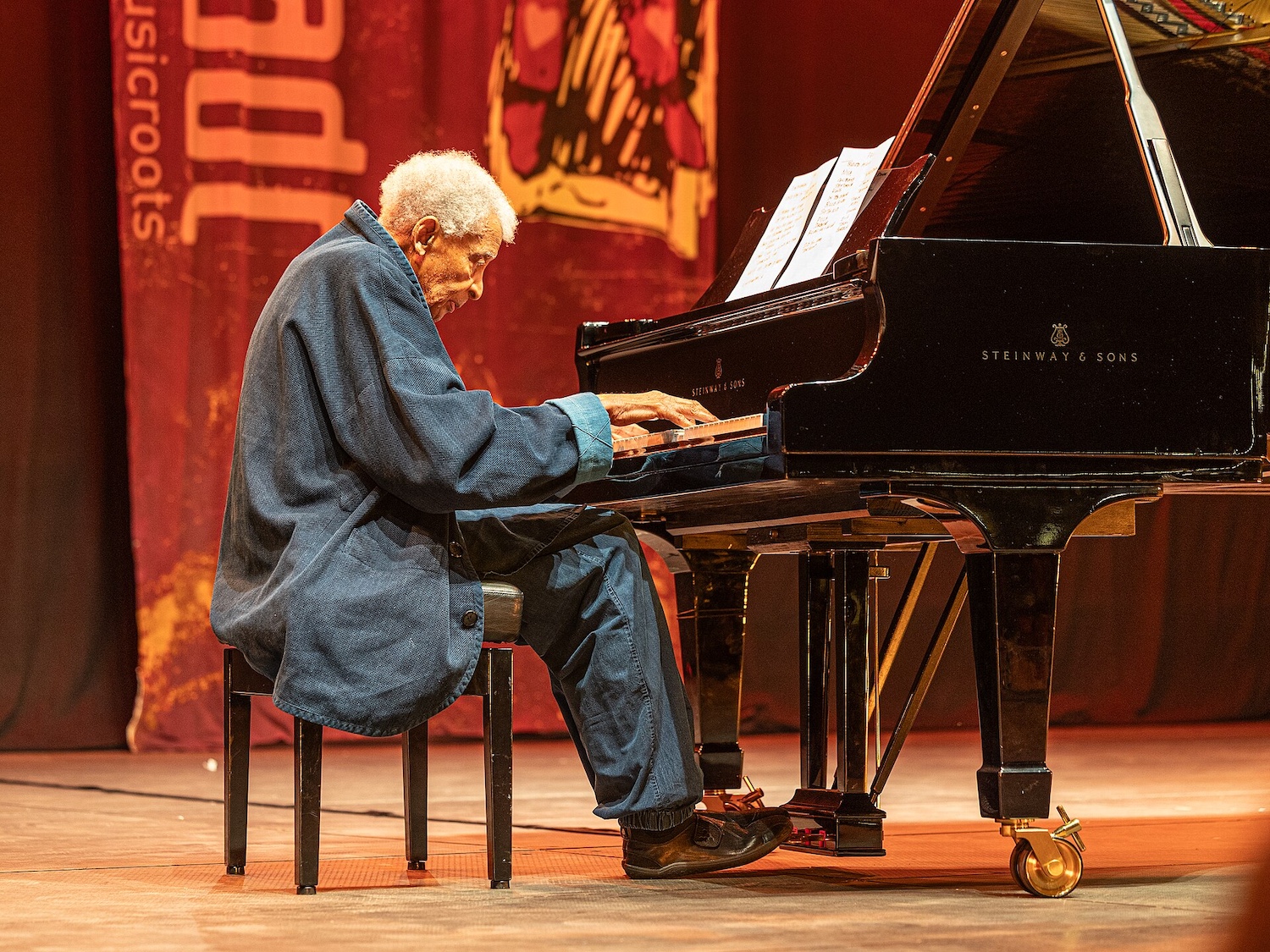
Abdullah Ibrahim
Abdullah Ibrahim, who sadly died on June 14th aged 91, the man Mandela called “Our Mozart”, has drawn on his wealth of experience to produce a string of small group and solo albums, sometimes dipping into and refashioning his own rich canon. Maraba from 2024 is a spare reworking of the sublime Maraba Blue from his Cape Town Roses album for instance, while Peace from Solotude is a reworking of the hymn-like Hamba Khale from the difficult-to-find 1974 record Confluence he made when known as Dollar Brand with the Argentinian tenor saxophonist Gato Barbieri. A recent Barbican solo concert underscored this. With quiet authority he commanded the stage, drawing upon his own distinctive output and still exploring still reaching for something new. The tunes meandered gently before resolving after twenty minutes or so. Pause to acknowledge applause: then on with confidence, into the unknown.
The Playlist
Features a selection of the music discussed to give a flavour of their variety. I couldn’t resist adding a joyful piece from Tony Allen and Hugh Masekela made in 2010, the only time they recorded together but never released in the Masekela’s lifetime and finished with young London musicians after he died.
Mike Flood Page
In his teens Mike Flood Page was gob-smacked by Monk, blown away by Hawk and Trane and seduced by Miles and Bill Evans. He nearly fell over the railings outside the old Ronnie Scott’s attempting to listening to Sonny Stitt without paying to get in. He failed to learn banjo, piano, guitar and tenor saxophone. In revenge he became a music critic for a few years. Having been found out he was forced to make a living in book publishing, magazines, TV, digital media, and academia before retiring gratefully to focus on his jazz habit.
Credits
Photo of Archie Shepp with pianist Lafayette Harris Jr. at the PDX Jazz Festival in Portland, Oregon, February 22, 2020. Photo by Dangerica Licensed under CC BY-SA 4.0.
Photo of Wadada Leo Smith and Amina Claudine Myers by Luke Marantz courtesy of Red Hook Records.
Photo of Abdullah Ibrahim at the Rudolstadt-Festival 2025. Photo by Harald Krichel/Wiki Portraits Licensed under CC BY-SA 4.0.
Recent Comments