
Given the uncertain, turbulent and crisis ridden nature of contemporary American politics, it is unsurprising how many present day American jazz musicians see their compositions and recordings as contributing to wider political statements and discourse. This is particularly true within the context of the Trump presidency, Black Lives Matter and the possibility of a second Trump presidential term.
Reading Downbeat, the U.S. jazz monthly of record over the last decade it is clear that their featured interviews and album reviews increasingly reflect the political dimensions of much contemporary jazz.
Recent albums and interviews by pianists Vijay Iyer and Jason Moran, saxophonists Orrin Evans and Wayne Escoffery, drummers Tyshan Sorey and Willie Jones 111 and trumpeter Ambrose Akinmusire all, in their different ways are keen to locate their music directly within the context of contemporary American politics. They all celebrate the radical nature of jazz and the important contributions of earlier generations of jazz musicians to the civil rights struggles of the 50’s, 60’s and 70’s.
I’ll return to these contemporary jazz voices in a future episode. On this occasion I want to look back to those earlier decades, which carry so many resonances to contemporary American politics.
Embarking on a professional jazz career in American in the four decades between the mid-20’s and 60’s placed African American jazz musicians in the front line of institutional and day-to-day racism that prevailed, particularly, but by no means exclusively south of the Mason-Dixon line. The dominant Jim Crow culture in many states required black musicians to stay in black hotels or with black families, frequently restricted their capacity to play to mixed audiences and in larger venues, exposed them to the discriminatory attention of local law enforcement, and to accept lower pay than many of their white counterparts.

We Insist!
“The road” was frequently a dangerous place. Many New York based musicians, including Charlie Parker were increasingly unwilling to tour the southern states. The national recognition achieved by Louis Armstrong, Duke Ellington or Count Basie did nothing to lessen these daily humiliations.
In the 1930’s Duke Ellington arranged to travel in his own pullman carriages to provide a comfortable and non-discriminatory environment for his musicians as they criss-crossed their home country.
The civil rights movement that emerged in the early 1950’s required jazz musicians to decide whether to actively support and reference the struggles for equality in their performance or to take a more nuanced stance. Louis Armstrong drew increasing criticism from within the jazz world and in the wider African American community for his light-hearted public persona, and agreeing to be the star attraction in numerous State Department world tours designed to showcase the country’s liberal and tolerant credentials. However, in 1957 he cancelled a planned State Department tour of the Soviet Union in response to the U.S. government’s refusal to enforce desegregation policies in support of the “Little Rock 9” He called President Eisenhower “two-faced” and described Arkansas governor Faubus as “an uneducated plow boy”. This contemporary interview with Pops gives an indication of his stance.
Duke Ellington, who studiously avoided directly political statements early in his career became a prominent supporter of civil rights campaigns in his interviews and statements throughout the 1950’s and 60’s.
A growing number of modern jazz musicians chose to link their music to specific demands for equal rights and to achieving the ambitions of the civil rights struggles. Prominent figures included Max Roach, Oscar Pettiford, Charles Mingus , Archie Shepp and the Art Ensemble of Chicago all of whom regarded their political activism as forming a central pillar of their musical expression.
The following compositions and album titles give an indication of the close association between jazz and the struggle for equal rights in the 1950’s and 60’s,
Max Roach – Deeds Not Words, We Insist! , Speak Brother Speak
Sonny Rollins – Freedom Suite
Art Blakey’s Jazz Messengers – Freedom Riders
Charles Mingus – Fables of Faubus
Oscar Peterson – Hymn to Freedom
Archie Shepp – Attica Suite
Oliver Nelson – Emancipation Blues
Lee Morgan – Search For The New Land
Nina Simone – Mississippi Goddam
Particularly significant was Max Roach’s We Insist album which in addition to his band of young players significantly featured Coleman Hawkins a jazz giant of a much earlier generation on a couple of tracks.
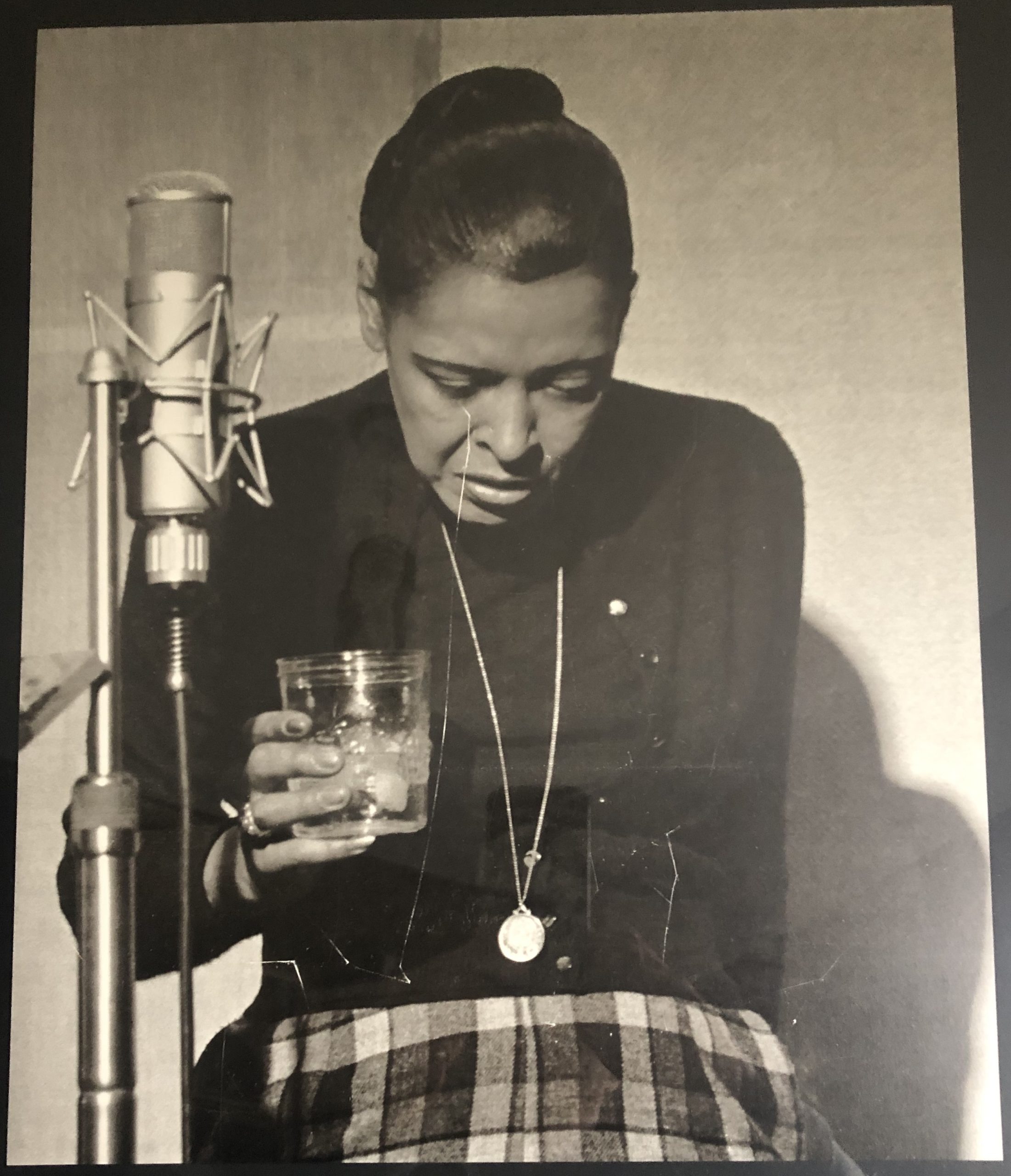
Billie Holliday
Billie Holliday featured the brutal story of a lynching, Strange Fruit as the closing number in her live shows throughout the 1950’s, an act which encouraged the FBI to increase their intrusive surveillance of her. Miles Davis, John Coltrane, Duke Ellington, and Sonny Rollins were among many star jazz performers to play benefit concerts the proceeds of which went to support the civil rights struggles.
Charlie Haden, the distinctive bass player who came to prominence with Ornette Coleman, openly voiced his broadly socialist outlook in the material he played and recorded with his Liberation Orchestra over three decades, The anthemic quality of many of these recordings were designed to attract support for liberation struggles within and beyond America.
The centrepiece of Sonny Rollins’s 1958 master work, Freedom Suite a four part composition running for 20 minutes. For Sonny, “It was an attempt to introduce some kind of black pride into the conversation of the time. That was my history”. He “really sweated over writing it” and insisted that the following statement was included in the album liner note,
“America is deeply rooted in Negro culture, its colloquialisms, its humour, its music. How ironic that the Negro, who more than any other people can claim America’s culture as his own is being persecuted and repressed, that the Negro, who has exemplified the humanities in his very existence, is being rewarded with inhumanity”.
All quotes from Saxophone Colossus Aidan Levy’s excellent recent biography of Rollins.
The Playlist
While my playlist is primarily sourced from instrumental recordings dating from the 1950’s and 60’s it kicks off with Big Bill Broonzy’s much earlier lament, Black, Brown and Beige and ends with Les McCann and Eddie Harris’s spontaneous treatment of Gene McDaniel’s protest song Compared to What? at Montreux which became an instant jazz classic. You will also find Billie’s incomparable Strange Fruit penned by the little known radical poet Abel Meeropol and John Lee Hooker’s contemporary account of the urban riots in Detroit in response to the assassination of Dr. Martin Luther King.
Recent Comments