
Coming hot on the heels of Miles Davis’s centennial the jazz world is awash with celebrations, events and reflections as we approach John Coltrane’s birthday on September 23rd, 1926.
Terence Blanchard and Ravi Coltrane, John’s son have just completed a tour-no doubt layered with significance given Ravi Coltrane’s participation. Joe Lovano now 70 a true jazz maestro is touring with a multigenerational Coltrane Legacy Band. I’ll be present for their performance in London in November (the tickets at the Barbican sold out within 24 hours). Branford Marsalis and Dianne Reeves have just issued Dedicated To You based on Coltrane’s memorable collaboration with baritone singer Johnny Hartman in the very early 1960’s. As I write Isaiah Collier representing the generation of under-30 saxophonists is touring his own take on Coltrane’s legacy and he’ll be bringing that project to the just opened Blue Note in London In December.
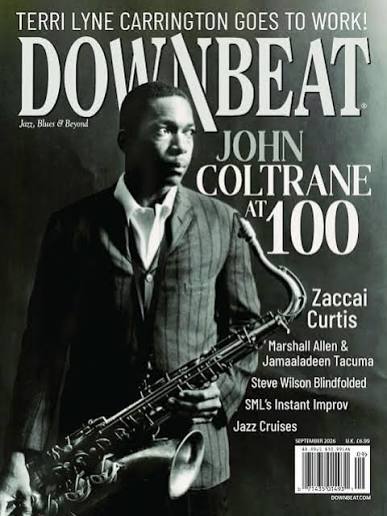
John Coltrane at 100 – Upbeat
Interesting to pair reflections from Joe Lovano a fabled jazz elder and Melissa Aldana an established sax maestra of the younger generation who will be co-leading the Coltrane tribute tour that I’ll be attending in November,
“It was legendary how much he practised and played, all day and every day and then performing until 4am before driving home to his babies. He’s just a young man striving in his 30’s and he shares that inspirational energy” – Lovano
“In his later years it was like he was trying to find a divine vibration, fee from any kind of preconceived limitations. He was deeply into the sound and totally free. That’s what always brings me back to him and it means that there will always be something new to find in his playing as we continue to listen” -Aldan
In this piece I reflect on three aspects of Coltrane’s life and legacy.
A LONG APPRENTICESHIP
Within the context of his own age cohort of jazz musicians John Coltrane took an unusually long time to establish his leadership credentials. From then on, his impact and influence within and beyond the jazz world was stratospheric. This was one of the many unique features of Coltrane’s creative life.
At the time that Coltrane was touring with King Kolax and Eddie “Clean Head “Vinson, Miles, Rollins, Max Roach and Fats Navarro were sharing stages and recording studios with bebop royalty, While his early core jazz engagements were with two jazz masters; Johnny Hodges the Ellingtoinian and Dizzy Gillespie the high priest of bebop, his own contributions failed to catch the attention of the jazz public and of jazz critics.
Throughout his first ten years as a professional musician following his demobilisation from the U.S. army in 1947, he studied and practiced ferociously. This would become a dominant feature of his musical life right until the end. Mastering harmony, developing his sound, finding his spiritual calling, aligning his astonishing technical abilities with his spiritual and -less overtly stated- political callings.
I would argue that Trane’s apprenticeship continued with his recruitment by Miles Davis in 1955 and with his legendary six month engagement with Thelonious Monk at the Five Spot in New York in 1958. By this time Trane had truly mastered his “sheets of sound” style, manically stacking chord sequences together at increasingly fast tempi. His participation with Miles Davis in the legendary Kind of Blue album in 1959 and the subsequent two years he spent with Miles and the influence of Bill Evans introduced him to the challenges of modal jazz where a handful of chords would form the basis of his long form solos. A whole world away from his highly complex harmonics culminating in his landmark composition and album aptly entitled Giant Steps.
A further element of Coltrane’s musical apprenticeship can be traced to the intensive series of his recordings initially as a sideman, subsequently as a leader between 1956 and 1960. It was through these recordings that Trane began to cement his reputation among fellow musicians and to fine tune his own capacity to add his own characteristic lustre to both jazz standards and original compositions. In his early years he was particularly influenced by Tadd Dameron, many of whose tunes he recorded.
So, by the time that Coltrane was ready in 1962 to become a true leader with his classic quartet assembled and firing he was aged thirty five with barely five years still to go.
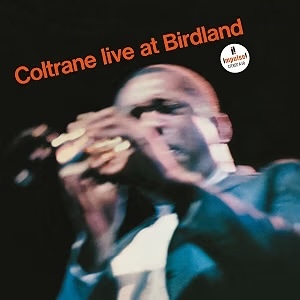
Coltrane Live at Birdland
A MAN IN A HURRY; AND A MAN OF FEW WORDS
By 1961 Coltrane had finally quit his heroin addiction, had definitively established his jazz credentials and was truly ready to strike out on his own distinctive path. From this point his unique, focus and ambition lay in an unyielding search for the best means of reflecting his personal search for meaning, truth and spiritual fulfilment in his music.
Coltrane’s increasing focus on spirituality was accelerated and deepened following his meeting with and marriage to Alice McLeod an established modern jazz pianist. After his death Alice Coltrane became one of the earliest and most significant vehicles of his legacy, particularly on the harp which Coltrane gifted her in the year of his death.
He also took important steps to secure and enhance his professional life. Establishing a vehicle -JOWCOL for registering and securing the rights to his compositions. Hiring a major bookings agency to manage his touring schedule-which remained within his preferred milieu of jazz clubs, and greatly enhancing the monetary value of his recording contracts particularly after the breakout success of My Favourite Things. Securing his financial security formed an important foundation to his capacity to play and record whatever he wanted, however demanding, however “uncommercial”. From the day he launched his classic quartet comprising himself, McCoy Tyner on piano, Elvin Jones on drums and Jimmy Garrison he personally set the tone of every performance, and each recording
John Coltrane was, by all accounts a shy and introverted character. He communicated minimally with his band, made no announcements on stage and only rarely gave interviews to the jazz media. Miles Davis recalls that on tour Coltrane would retreat to his hotel room to read and practice after gigs and rarely socialized with the band. However, there is much evidence from colleagues such as Sonny Rollins, McCoy Tyner and Archie Shepp that he was happy and able to engage in deep conversations about music and his own musical journey away from the bandstand.
And Coltrane never stood still. Even after finding his ideal quartet vehicle, he continued to experiment adding instrumentation, particularly from younger players, lengthening his solos, adding soprano, flute and bass clarinet to his repertoire ( he was learning the bagpipes in the months before his death). In the end it was the pressure to change and the increasing volume and chaos of his music that prompted Elvin and McCoy to part company with John. They had offered him all that they could and recognised that John was set on new paths which they could not add value to.
And finally, while in one sense Trane was moving into much freer, more spontaneous directions in his final years he continued to play ballads and many of the tunes that he was most famous for in his live recordings. My Favourite Things stayed in the mix right until the end
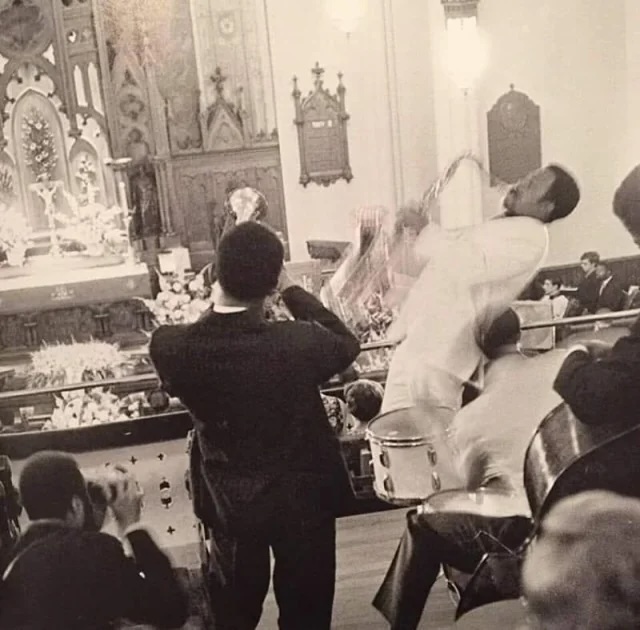
John Coltranes Funeral at St Peters Church
SAINTHOOD AND LEGACY
Professional historians enjoy setting out counterfactuals-posing and attempting to answer “What would have happened if “questions. In John Coltrane’s case it is impossible to imagine where his musical journey would have led had he been granted another few decades of life, and he was only 40 at his death. There is a strong sense that Coltrane had no idea how seriously ill he was in his final months, had communicated little or none of it to his immediate circle and did not seek conventional medical attention until it was too late. Could it be that the furious intensity that characterized his last couple of years derived in some part of his realization that he did not have long to live? We can only speculate.
This quote from his final drummer Rashied Ali gives an indication of his mindset in that concluding period
“He’s put the horn down, beat on his chest and screamed into the microphone. People really thought he had lost his mind then”
As does this review from Downbeat in late 1965,
“One simply couldn’t hear anything but drums…at one point I saw John Coltrane break out a bagpipe and blow into it, but damned if I heard what he played”
A more positive and considered contemporary reflection comes from saxophonist James Brandon Lewis,
“In Coltrane’s later period we have an artist who is at such a masterful level that his playing has moved beyond our immediate understanding”
What is for certain is that John Coltrane’s musical legacy continues to impact on every succeeding generation of jazz musicians right up to the present day. Only Charlie Parker had an equivalent and continuing relevance to the contemporary jazz scene.
And in a way it is fitting given his profoundly spiritual nature that in 1969 the St John Coltrane African Orthodox Church was established in San Francisco. It still exists.
The Playlist
Given Coltrane’s voluminous recording legacy which is still being added to as new lost material comes to light narrowing the choices down has not been easy. I’ve been guided by performances that have particularly resonated with me personally while trying to reflect the different stages of his musical development from close to the beginning to near the end. I hope you do enjoy.
Recent Comments