
As regular and even occasional readers of my blog will know my musical life and interests have been characterised by a lifetime immersion in the wonders of modern jazz since 1969 and the first Stan Tracey gig I attended at a deservedly obscure location in Finchley, North London.
I love the music, the folklore and literature associated with jazz, its immediacy the surprise factor in almost every performance. I am drawn jazz people, jazz argot and jazz clubs.
While jazz sits somewhere near the bottom of the money-earning musical food chain in terms of originality, immediacy and surprise it is hard to beat. I continually marvel at the commitment, the learning, the “chops” it takes to launch and sustain a career in jazz. And I’m so grateful for the unique contribution that jazz continues to make to the wider musical scenes from contemporary classical, through R and B, soul, hip hop, to opera, «world music”, bossa and choral genres. What I can only describe as jazz sensibility continues to impact on the work contemporary writers, designers and artists.
So, while my lifetime engagement with this great music has been primarily in the guise of a listener, attending numerous gigs, building my library of jazz recordings-vinyl, CD and now streamed I have always had an alto sax in my possession.
Back in 1970 the alto sax in my mind formed a direct connection with that rare genius Charlie Parker. It represented the quintessential voice, sound, and timbre of modern jazz. So, my first purchase was an ancient alto compiled from different components with leaky pads and doubtful provenance. I attended jam sessions as a student long before I was ready and keenly recall a couple of particularly humiliating experiences when a tune was called in a key I didn’t know. I played in a student quintet which made a name for itself in murdering some of the great modern jazz compositions of the mid-20th century.
In the early 70’s I took a few lessons with two UK jazz greats Stan Tracey and Peter King- although I was too green, and they were too uncommunicative to take too much from those sessions. I did pass an intensive fortnight in 1973 with the great bass player Harry Miller learning about the connections between jazz and South African township music. Listening to The Brotherhood of Breath, Chris McGregor’s explosive big band in which Harry held the bass chair remains one of the standout musical memories of my life.
From that point on work took on an increasingly high profile in my life. While I continued as an active listener and gig attender, I was only an occasional player. My sax stayed undisturbed in its case for months at a time.
Of course, I always recognised the patent absurdity of one of the recurring urban myths about jazz, namely that improvisation is an entirely spontaneous undertaking with no or few links to musical learning. Nothing could be further from the truth. Deep knowledge of musical theory and harmony form the essential bedrocks of all jazz musicians’ D.N.A. So, I always knew that if I was to return to playing, I’d need to earmark serious time to study and practice and that opportunity coincided with my decision to retire from a full on public service career in 2013. I could finally find the time to devote to studying the lingua franca of jazz-as a player, as well as a listener.
A major early feature of my return to playing was attending regular Saturday jazz workshops in Hackney, East London. This led to rehearsal opportunities with keen amateur musicians many of whom I’d met through the workshops. We formed a quintet named Footprints after the Wayne Shorter composition and began to gig regularly mainly in an often rowdy café in Hackney. That band comprised Alan Durant on bass, David Buckingham on baritone sax, Adrian Samuels on drums and Nick Skates both pianists-Nick sadly died in 2022 and me on alto.
My path to becoming a player really began with a two year jazz theory course in London led by an inspirational teacher Cerys Hogg at the City Lit in London. It was there that I met my new friends and current band mates pianist Terry Loane who following a BMus. and much experience in the UK folk scene was becoming increasingly drawn to jazz and Greg Loops an American émigré and guitarist who had just taken up the bass and was also keen to build up his jazz knowledge. At that stage what I could bring to the table was my years of deep immersion in jazz, knowledge of the tunes, musicians and culture. A few years later we were introduced to James Lewis, a great drummer with a deep immersion in the music who had been a jazz professional in the 60’s and was playing regularly in big bands and jazz rock outfits and was wanting to get back to small combo modern jazz.
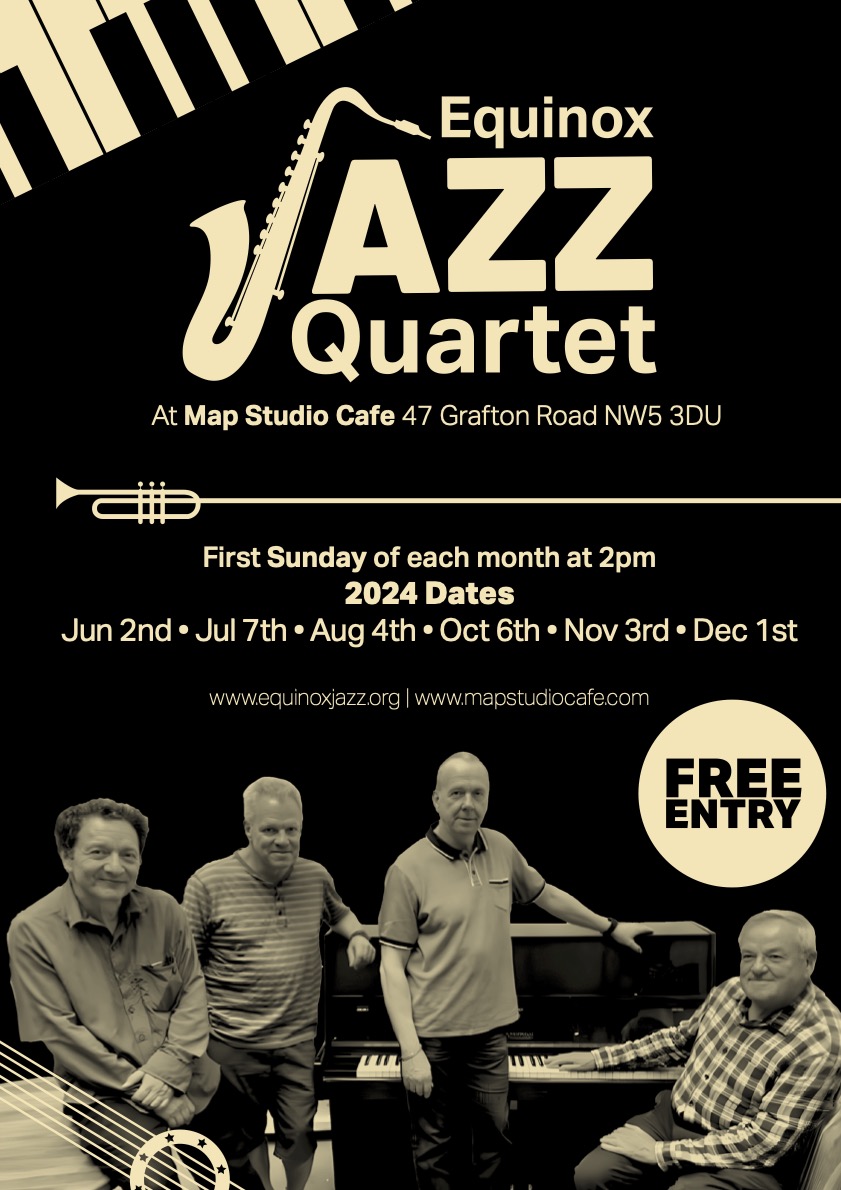
Together we now comprise the Equinox Jazz Quartet a band whose repertoire is based on many of the great compositions of such jazz luminaries as Coltrane, Monk, Sonny Rollins, Miles Davis, Benny Golson and Herbie Hancock. We have a regular monthly residency at MAP Studio a small club in Camden and play other venues too. We practice individually, rehearse new material together and now gig regularly.
So, as I write daily practice is a core part of my routine and last month the Equinox Jazz Quartet recorded our debut album in a pro. recording studio in Norwich which should be out in the autumn. Watch this space!
To say that I am surprised and delighted by this turn of events would be an understatement.
I have learnt a great deal from my late-in-life experience as a jazz performer
- Give serious thought to the shape and balance of tunes within each set
- Sets shouldn’t last more than 45 minutes.
- Vary the approach-nothing is worse than playing each tune in the same way-“head”, solos, “head”.
- Get the balance right between agreed approaches to tunes and the opportunity to try new things
- Jazz is fundamentally an acoustic art form, too many jazz gigs even in small venues are over-amplified
- Buy the best instrument you can. I have never regretted buying my second hand Selmer Reference 54 alto, twice my planned budget but it has served me well. It’s not the easiest horn to play but its sound and intonation are unique and jazzy.
- Engage with your audience, don’t approach gigs as an open rehearsal
- Becoming a good interpreter of great compositions is as valuable as writing original material
- Becoming a better player has made me a more discerning listener
- Always look for new opportunities to play
The Playlist
My playlist is made up of 3 sets of music that we regularly feature at EJQ gigs. Many of these tunes will appear on our upcoming album.
“If you feel it, it’s right. If you think it is it’s probably not right” – Joe Henderson
A great read which brought memories back! I realised how much I missed listening to EJQ. Hope to listen to your debut soon! Keep well, all of you.